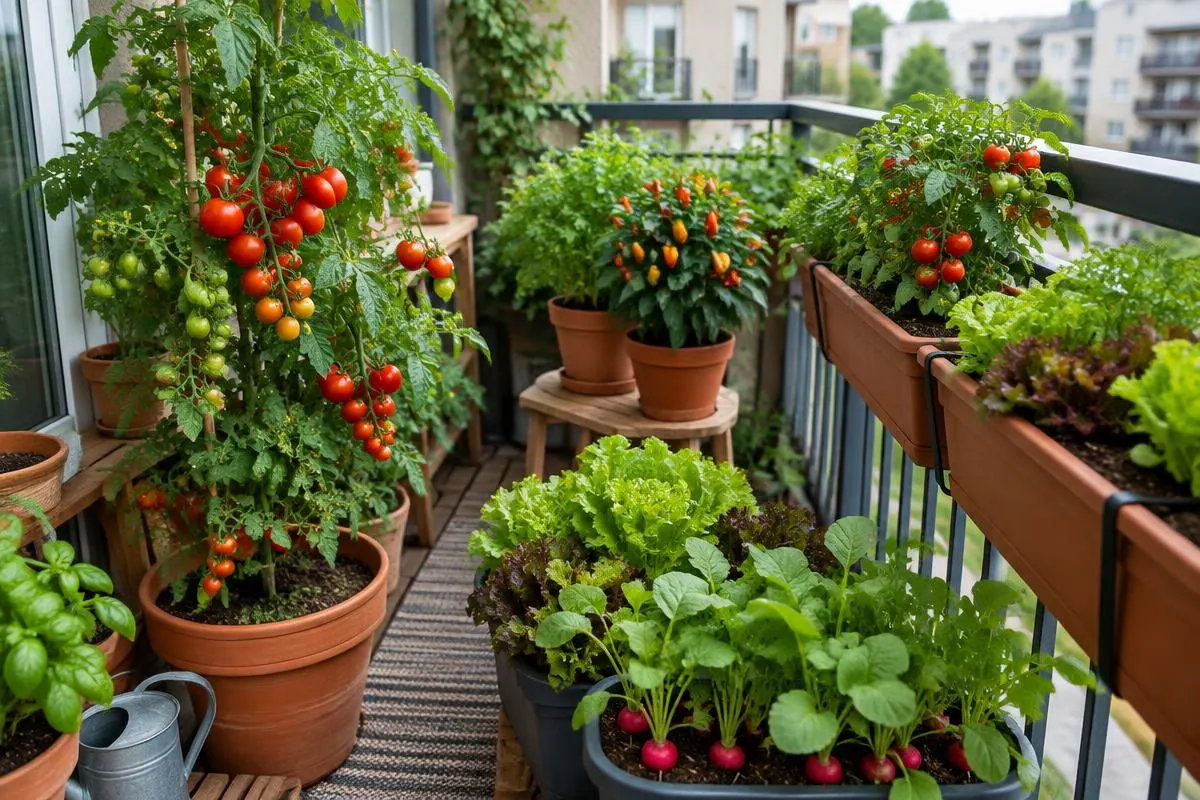
Which vegetables grow on a north-facing balcony? Leafy greens, peas and herbs that tolerate shade, container sizes, seasons and honest expectations.
Start smaller than you think. A few well-matched plants teach you more than a crowded balcony that is difficult to water and inspect.
How much sun does a north-facing balcony get?
In the Northern Hemisphere the sun travels across the southern sky, so a north-facing balcony sits in the building's own shadow for most of the day. Many get no direct sun at all from autumn to spring. In midsummer, some receive an hour or two of low sun early in the morning or late in the evening, when the sun rises and sets further north. What they do get is open daylight from the sky — bright shade — and that is what leafy vegetables run on. In the Southern Hemisphere, the same applies to a south-facing balcony.
- Track your real light for one day before buying plants — overhangs and neighbouring buildings matter as much as direction
- Bright shade with open sky overhead is far more productive than a dim, enclosed corner
- Spots at the railing edge usually get more light than the back wall
Related guides: How to Determine How Much Sun Your Balcony Gets · Best Plants for Shady Balconies
Why most fruiting vegetables struggle here
Tomatoes, peppers, eggplants, cucumbers, squash and beans grown for pods all need energy to flower and ripen fruit. They are generally recommended about 6 or more hours of direct sun. On a north-facing balcony they tend to grow tall and leggy, flower poorly and set little or no fruit. You can try a cherry tomato if you get a few summer hours of direct sun, but treat it as an experiment rather than a plan. Crops you eat as leaves, shoots or small roots are a much better match.
Vegetables and greens that tolerate partial shade
These crops commonly tolerate light shade. Shade tolerance does not mean the same harvest as in full sun: expect slower growth, smaller plants and longer waits. Sow little and often for a steady supply.
Loose-leaf lettuce
The most reliable choice. Cut-and-come-again varieties let you pick outer leaves for weeks. In summer, shade actually helps by slowing bolting.
- Container depth: 15–20 cm (6–8 in)
- Time to first picking: Often 4–7 weeks; longer in shade
Spinach
Prefers cool weather and copes with limited light, which makes it a good spring and autumn crop on a north balcony.
- Container depth: 15–20 cm
- Best season: Spring and autumn
Swiss chard
Tolerant, long-lasting and attractive. One plant can be picked for months if you take a few outer stems at a time.
- Container depth: 20–25 cm
- Harvest: Outer leaves, a few at a time
Kale
Grows slowly in shade but is hardy and productive over a long season, including cool months in mild climates.
- Container depth: 25–30 cm
- Best season: Late summer to winter
Asian greens and salad mixes
Mizuna, mustard greens, pak choi and baby salad mixes grow quickly and are harvested young, which suits low light.
- Container depth: 15 cm
- Harvest: Baby leaves in roughly 3–5 weeks
Pea shoots and microgreens
Instead of waiting for pods, grow peas densely and cut the tender shoots. Microgreens need only a shallow tray.
- Container depth: 5–10 cm
- Harvest: Shoots in about 2–4 weeks
Radishes and green onions
Radishes form roots in partial shade, though they may be smaller. Green onions and chives are easy, steady pickers.
- Container depth: 15–20 cm
Plant comparison table
Use this as a quick shortlist. Sunlight ranges are general guidelines; seed packets and local extension services may differ.
| Crop | Approx. direct sun | Shade tolerance | Pot depth |
|---|---|---|---|
| Loose-leaf lettuce | 2–4 hours or bright shade | Good | 15–20 cm |
| Spinach | 2–4 hours or bright shade | Good | 15–20 cm |
| Swiss chard | 3–4 hours | Good | 20–25 cm |
| Kale | 3–4 hours | Moderate | 25–30 cm |
| Asian greens / salad mix | 2–3 hours | Good | 15 cm |
| Pea shoots, microgreens | Bright shade | Good | 5–10 cm |
| Radish | 3–4 hours | Moderate | 15–20 cm |
| Tomatoes, peppers | 6+ hours | Poor | 30 cm+ |
Container sizes and drainage
Shade slows evaporation, so containers on a north balcony stay wet longer. That makes drainage more important, not less. Every pot needs an open drainage hole; a decorative cover pot without one will drown roots.
- Use fresh potting mix made for containers, never garden soil
- Wide, shallow troughs suit most leafy crops better than deep narrow pots
- Water by feel: push a finger in and water only when the top 2–3 cm is dry
- Raise pots on feet so water drains freely and does not stain the balcony floor
Related guides: Best Pots and Containers for Balcony Gardening · How Often Should You Water Balcony Plants?
Seasonal differences
Your best seasons are spring and autumn, when leafy crops like cool weather and the sun angle matters less. Summer is often the only time a north balcony sees any direct sun; use it for lettuce and chard, which bolt quickly on hot sunny balconies. In winter, light levels drop sharply. In mild climates kale, spinach and hardy salad greens may keep going slowly; in cold climates, expect a pause until spring.
Related guide: What Plants Do Great on a Balcony in Winter
Practical growing recommendations
A simple first season on a north-facing balcony might be one trough of loose-leaf lettuce, one pot of chard, a tray of pea shoots and a pot of chives. That is enough to learn how your space behaves without crowding it.
- Put the hungriest plants at the brightest spot, usually nearest the railing opening
- Sow small batches every 2–3 weeks rather than one big sowing
- Feed lightly with a balanced liquid fertilizer every few weeks once plants are growing
- Check for slugs and aphids — shaded, damp corners attract them
- Keep a short note of what grows best; next season, grow more of that
Common questions
Can you grow vegetables on a north-facing balcony?
Yes, mainly leafy greens such as lettuce, spinach, chard, kale and Asian greens, plus pea shoots, microgreens and green onions. Fruiting crops like tomatoes usually need far more direct sun.
Will tomatoes grow on a north-facing balcony?
Usually not well. Tomatoes generally need about 6 or more hours of direct sun to fruit. If your balcony gets a few summer hours of direct light you can try a compact cherry tomato, but expect a small crop or none.
What is the easiest vegetable for a shaded balcony?
Cut-and-come-again loose-leaf lettuce is the easiest starting point. It grows in bright shade and lets you pick leaves over several weeks.
How often should I water plants on a north-facing balcony?
Less often than on a sunny balcony. Check the soil with your finger and water only when the top 2–3 cm feels dry; overwatering is the more common problem in shade.